The words of Jesus, gathered into one book by Thomas Jefferson.
In 1820, with a razor and glue, Thomas Jefferson took the moral teaching of the four Gospels out of six New Testaments, in Greek, Latin, French and English, and arranged it into a single, continuous account of the life of Jesus. He set the miracles aside. He kept the words.
“I am a Christian, in the only sense in which he wished any one to be; sincerely attached to his doctrines, in preference to all others.”
Thomas Jefferson, letter to Dr. Benjamin Rush, April 21, 1803
The book
One continuous account of Jesus, taken word for word from the Gospels.
The Life and Morals of Jesus of Nazareth is not a commentary, not a paraphrase and not a new translation. Every line in it is scripture. What Jefferson did was to choose, and then to arrange.
I
What it is
A short book containing only the words and acts of Jesus, placed in the order in which Jefferson judged that they happened. It opens with his birth in Bethlehem, follows the teaching and the journeys, and closes at the tomb with the stone rolled against the door.
II
How it was made
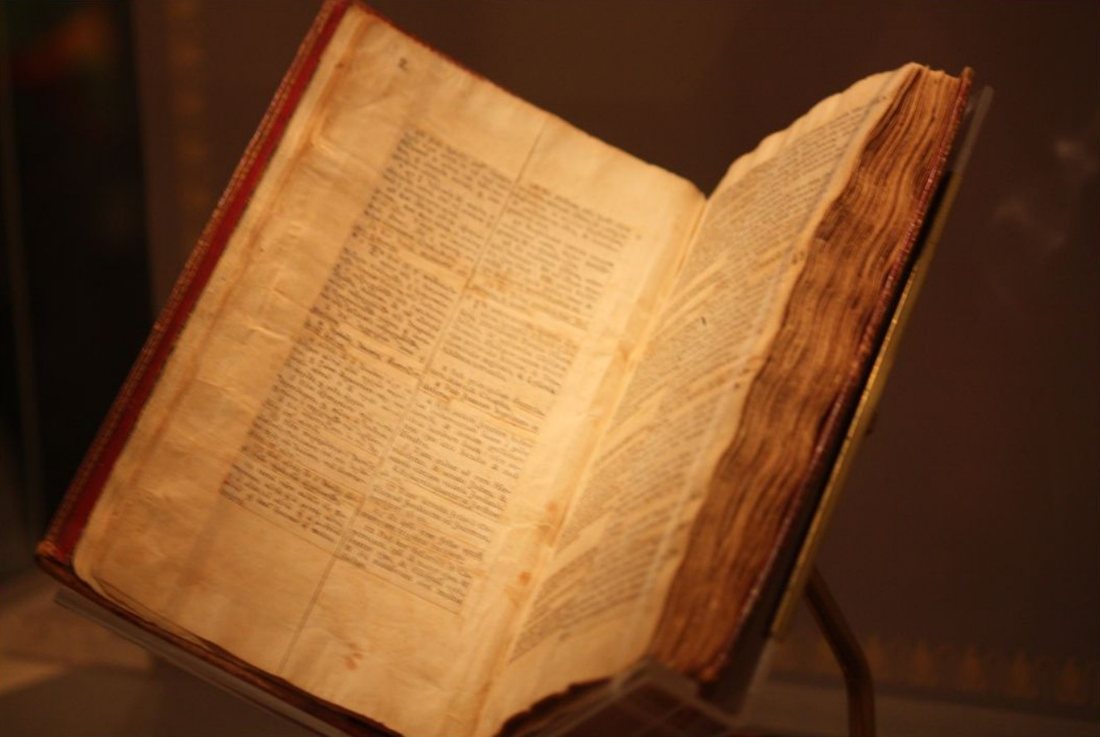
With a razor and paste. Jefferson cut the verses he trusted out of his own copies of the New Testament and glued them onto blank paper, keeping four languages side by side in parallel columns: Greek, Latin, French and English. He worked at Monticello in 1819 and 1820, and he never published it.
III
What he set aside
The supernatural: the annunciation, the miracles of healing, the walking on the water, the resurrection and the ascension, together with the long genealogies and the passages he believed had been added by later hands. He did not deny that others held these things sacred. He simply did not include them in his own book.
IV
What he kept
The Sermon on the Mount, the Beatitudes, the Lord's Prayer, the Golden Rule, the parables of the Good Samaritan and the Prodigal Son, the widow's mite, the call to forgive, to give, to serve and to love. This is the heart of the Gospel, and it is all still there.
Three editions
The same complete text, in the format that suits you best. Kindle is sold in your local Amazon store; paperback and hardcover are sold on Amazon.com.
Digital
Kindle
Read it today on your phone, tablet or Kindle. Instant delivery, no shipping and no waiting.
The sample opens in the Amazon reader; if you do not have an account, you can create one for free.
The man behind the book
Who was Thomas Jefferson?
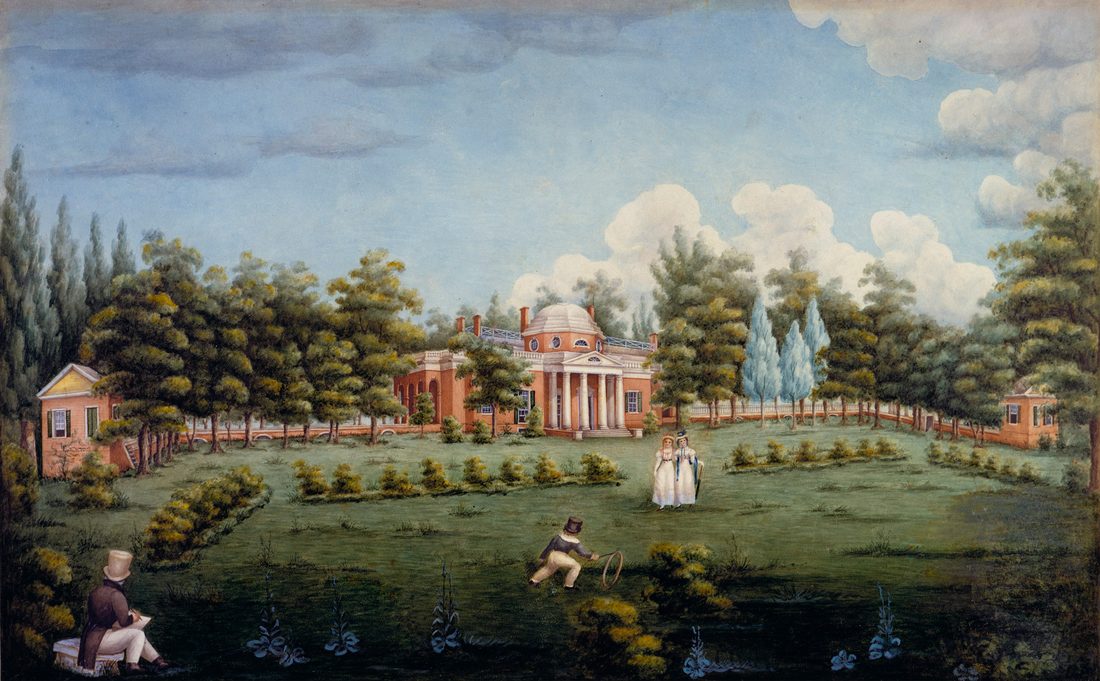
Monticello, Virginia, in a nineteenth-century view. The house Jefferson designed, and where he cut and pasted his book.
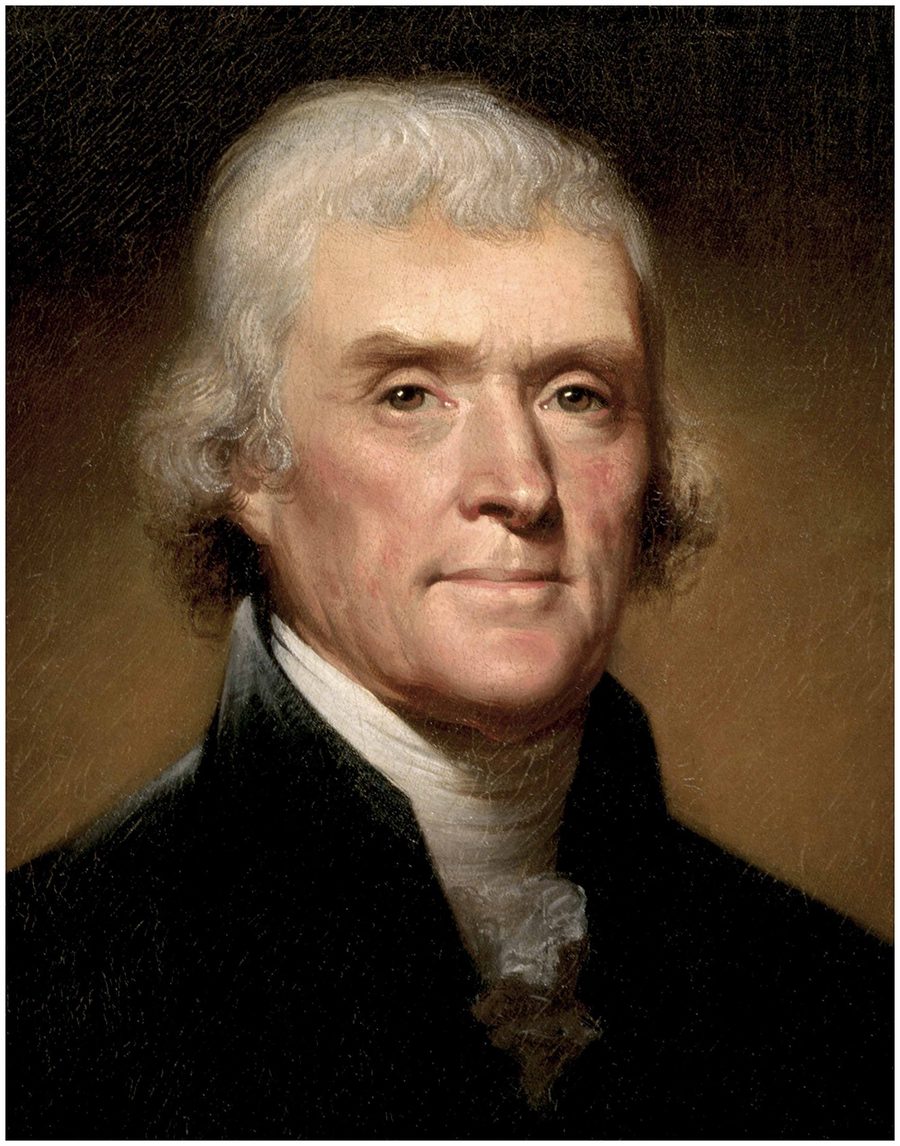
Thomas Jefferson (1743–1826) was the third president of the United States, the principal author of the Declaration of Independence, an architect, a farmer, a naturalist and the founder of the University of Virginia. He was also, all his life, a serious reader of the Bible.
He was not a man of the pulpit. He seldom attended church, he questioned the Trinity, and he refused to hand his religion over to anyone else. But he was far from indifferent to Jesus. He called the teaching of Jesus “the most sublime and benevolent code of morals which has ever been offered to man”, and he spent years of his retirement reading it closely enough to know which verses he trusted and which he did not.
His hope was that if the words of Jesus were gathered together, without the doctrine built around them, readers would find a teacher they could follow rather than a mystery they could not explain.
A short timeline
1743Born at Shadwell, in the Virginia countryside.
1776Drafts the Declaration of Independence at the age of thirty-three.
1801–1809Third president of the United States.
1804Completes The Philosophy of Jesus of Nazareth, a first, shorter attempt. No copy of it survives.
1819Founds the University of Virginia, and begins the second and fuller book with his razor and his glue.
1820Finishes The Life and Morals of Jesus of Nazareth at Monticello, in four languages, for his own use.
1826Dies at Monticello on the fourth of July, fifty years to the day after the Declaration.
1895His papers and the little book reach the Smithsonian Institution.
1904Congress prints the book for the first time; for decades afterwards, new members of Congress were given a copy.
TodayThe original rests in the National Museum of American History, and the text is in the public domain for anyone to read.
His purpose
Why he made it
Jefferson never wrote against Jesus. He wrote against everything he believed had been attached to him. His complaint was simple: the teacher had been buried under the explanations.
“In extracting the pure principles which he taught, we should have to strip off the artificial vestments in which they have been muffled by priests.”
Letter to John Adams, October 12, 1813
“To the corruptions of Christianity I am, indeed, opposed; but not to the genuine precepts of Jesus himself.”
Letter to Dr. Benjamin Rush, April 21, 1803
“The matter is evidently his, and as easily distinguishable as diamonds in a dunghill.”
Letter to William Short, April 13, 1820
Three things he wanted
To hear Jesus clearly. He believed the moral teaching of Jesus was the purest and most benevolent ever offered to mankind, and that it deserved to be read on its own.
To separate the teacher from the institution. Creeds, councils and clergy, in his view, had turned a way of life into a system of power.
To make it short enough to actually read. He wanted a book he could open in the evening and finish — a life of Jesus in an hour or two, not a library of commentary.
The original volume, open: the verses cut out and pasted by hand in four parallel columns — Greek, Latin, French and English. Kept today by the Smithsonian Institution.
A private book, made public. Jefferson was careful never to print it. He wrote that he was “averse to the communication of my religious tenets to the public”, and the little book stayed in his family for seventy years after his death. It reached the Smithsonian in 1895, was printed by Congress in 1904, and has belonged to every reader since.
Who it is for
Perhaps this book was made for you.
Jefferson gathered these pages for himself. Readers have been gathering them ever since, often for reasons they recognise the moment they open the cover.
If you love Jesus but not religion
You may love the Sermon on the Mount and still feel out of place in a building. Here is the teaching without the institution: no creed to sign, no hierarchy to obey, no mystery you are asked to accept first. Only the words.
If parts of the Bible trouble you
Many honest readers are stopped cold by passages that seem to bless cruelty, to accept servitude as a fact of life, or to treat women as property. Those texts belong to the ancient world that produced them. Jefferson's book leaves them outside the covers and keeps the ethical teaching, the mercy, and the call to love your neighbour as yourself.
If the miracles are the obstacle
If you cannot believe that water became wine, that is no reason to lose the Golden Rule. Jefferson separated the moral teaching from the supernatural account, so that a reader may accept the first without being required to swallow the second.
If you are searching, or grieving
There is a reason people in hard seasons keep returning to these sayings. Blessed are they that mourn. Come unto me, all ye that labour. Ask, and it shall be given you. Short sentences, quietly spoken, that have outlasted every empire that tried to own them.
If you are curious about Jefferson
The book is also a self-portrait. A president in his seventies, alone with a razor and a Bible, deciding one verse at a time what he believed. Few documents reveal a mind so plainly.
If you teach, or study, or translate
The original keeps Greek, Latin, French and English on facing pages, which makes it a quiet marvel for anyone who works with texts, and a gentle first step for anyone learning what Jesus actually said.
What this page is. We are not a church and we do not speak for any congregation. This is an invitation to read a book, offered by readers of the book: the account of Jesus that Thomas Jefferson kept for himself. Whether you believe everything in it, some of it, or are still deciding, you are welcome here.
A gift
A gift for someone who has drifted away.
Many people have not lost their love of Jesus. They have lost their patience with everything that has been built on top of him. If you know someone like that — a brother who stopped going, a friend who was hurt by a church, a parent who says he believes in the teaching but not the wonders — this is a book you can hand over without an argument attached to it.
It says, quietly: here is Jesus, and here is nothing else. No claims to defend, no institution to join. Just the words, gathered by a man who believed they were the best ever spoken.
An honest gift for a hard season, and a gentle one:
Christmas, or the quiet week after it
Easter, for someone who no longer goes
A baptism, a confirmation, or a first communion
A graduation, a move, a new beginning
A hospital room, or a house where someone is grieving
A birthday for a reader who has everything
Jesus of Nazareth.
Explore the Original Manuscript
“Any edition combines a faithful transcription of Thomas Jefferson’s manuscript with digitized images, allowing readers to consult the original document directly.”
Read the transcription. Explore the original. Discover the history.
Questions
Honest answers to the usual questions.
Is this the Bible?
It is the four Gospels, arranged differently. Every sentence in the book comes from the Gospels; Jefferson did not rewrite or translate anything. He chose passages and put them in order. What he left out were the miracles and the claims that Jesus was God, so the book reads as one continuous story of a life and a teaching, from Bethlehem to the sealed tomb.
Is it anti-Christian?
No. Jefferson wrote that he was “a Christian, in the only sense in which he wished any one to be”, and he called the teaching of Jesus the most sublime and benevolent code of morals ever offered to man. He questioned certain doctrines and rejected the miracles. He did not reject the teacher. Readers of many churches find their own faith in these pages.
Did Jefferson own slaves?
Yes, for his whole adult life, and this belongs to the story as much as the book does. He wrote against slavery in the strongest terms. Reading his little book does not require pretending that away. It does mean sitting with a man who, from a position of privilege, could see the moral content from the words of Jesus.
Do I have to agree with Thomas Jefferson to read it?
No. The text is not his opinion; it is the Gospel. You may read it as a believer, as a doubter, as a historian, or simply as someone curious to know what Jesus said when the miracles are taken out of the room.
Which edition should I buy?
Any complete edition is fine — what matters is that it contains the whole text without cuts or modern rewrites. Facsimile editions reproduce the original four-language pages, with Greek, Latin, French and English side by side. And in fairness: the 1904 text is in the public domain, so it is also free to read. We would rather you read it than not. A printed copy is simply the version you can hold, lend, underline and give away.
Is this page connected to the Smithsonian or the government?
No. lmjn.org is an independent page, made by readers of the book. The original manuscript, bound in red leather and written in Jefferson's own hand, is held by the Smithsonian Institution's National Museum of American History, which has nothing to do with this site.
Why make a website about a book that is free?
Because most people have never heard of it, and those who need it most are rarely the ones browsing a library catalogue. A president once kept this book for his own evening reading. We think it deserves a wider circle of readers than that.
Read it once, and you will not read the Gospels the same way again.
A short book, made by a president in his own hand for his own quiet evenings, and given to the rest of us almost by accident. It is not a heavy volume. It is one evening, and then a lifetime of going back to it.